

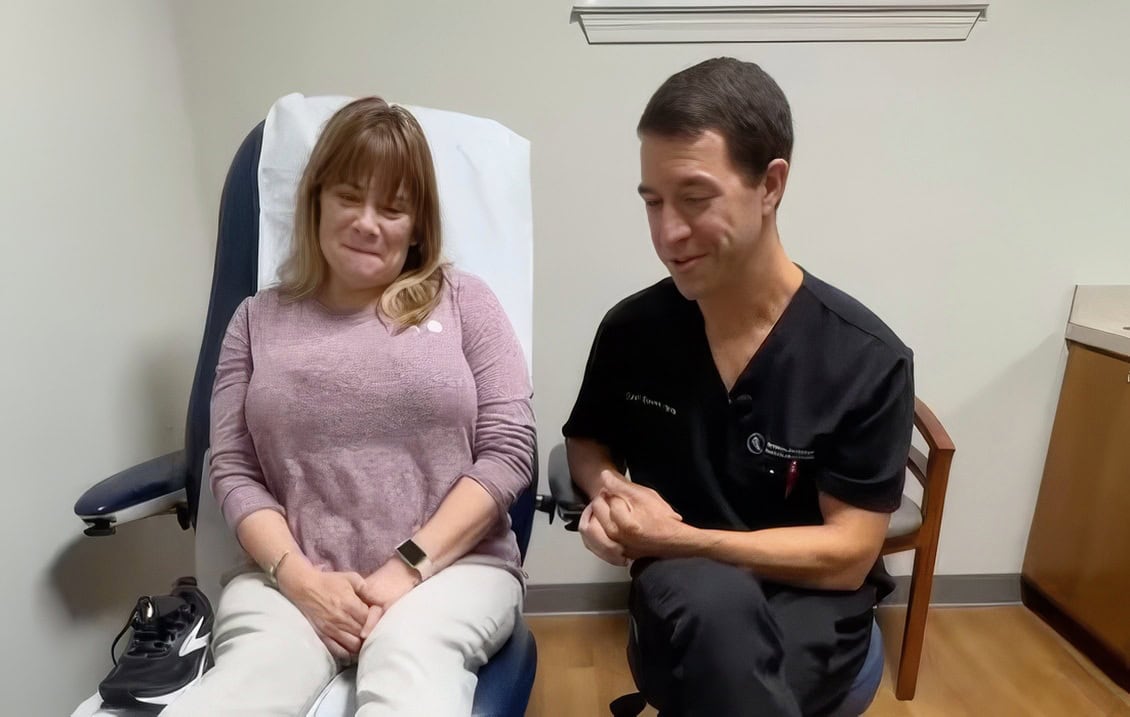
A bunionette, or tailor's bunion, is a painful bump on the outside of the foot at the base of the little toe. Many cases improve with wider shoes, padding and orthotics. When pain persists, Dr. Carl Speer can correct it with InvisiFoot™, done in-office.
Most people have heard of bunions at the big toe, but far fewer know the same kind of problem can develop on the other side of the foot. If you have a red, sore bump beside your pinky toe that rubs in every pair of shoes, you may be dealing with a bunionette. At Emerald Coast Foot and Ankle Center, bunionettes are one of the structural conditions Dr. Speer treats every week at our Pensacola office. This guide explains what causes them, what you can try first and what minimally invasive correction involves.
What Is a Bunionette?
A bunion on the outside of the foot
A bunionette develops when the fifth metatarsal bone, the long bone behind your smallest toe, begins to protrude outward while the little toe angles inward. The result is a bony prominence on the outer edge of the forefoot. It is similar in nature to a traditional bunion, which forms at the base of the big toe, but it affects the smaller side of the foot. You can compare the two on our conditions page.
Why it's called a tailor's bunion
The nickname dates back centuries, to tailors who sat cross-legged for hours with the outside edges of their feet pressed against the floor. Constant pressure on that spot was blamed for the bump, and the name stuck.
How it differs from a corn or callus
A bunionette is a change in bone alignment. Corns and calluses are thickened skin that often form on top of a bunionette because of friction. Treating only the skin gives temporary relief, but the bump underneath remains.
What Causes a Bunionette?
Inherited foot structure
The shape of your foot and the angle of your fifth metatarsal are largely inherited. Some people are simply built with more of a tendency to develop the bump.
Tight or ill-fitting shoes
Narrow, pointed or tight shoes squeeze the forefoot and press on the outer edge of the foot, which can speed up the problem and make symptoms much worse.
Arthritis and repetitive stress
Arthritis and repeated pressure on the outside of the foot from certain activities can also contribute.
What Are the Symptoms?
Common signs
- A visible bump on the outside of the foot near the little toe
- Redness, swelling or a burning sensation over the bump
- Pain that worsens in closed or narrow shoes
- A corn or callus forming over the bump
- The little toe angling toward the fourth toe
Why symptoms tend to worsen
Symptoms tend to worsen over time if not addressed. The bump creates friction inside your shoes, which leads to irritation and inflammation, and as the alignment changes, fitting into shoes becomes harder. Early evaluation is important.
How Is a Bunionette Diagnosed?
A hands-on exam with Dr. Speer
Dr. Speer examines the foot, watches how you stand and walk, and checks where your shoes are rubbing. He will ask about your activities and footwear, since both affect treatment choices.
Onsite digital X-rays
Emerald Coast Foot and Ankle Center offers onsite digital X-rays, so you can get fast answers in a single visit. X-rays show the angle of the fifth metatarsal, whether the bone has an enlarged prominence, and whether arthritis is present. The images are available immediately, so Dr. Speer can review and explain them with you during your appointment.
What Non-Surgical Treatments Help?
We take a compassionate, conservative-first approach. In many cases, non-surgical treatments offer real relief.
| Treatment | How it helps | Best for |
|---|---|---|
| --- | --- | --- |
| Shoe modifications | Wider toe box reduces pressure on the bump | Nearly every patient |
| Padding | Cushions the bump and reduces friction | Mild to moderate symptoms |
| Orthotics | Improves foot mechanics and pressure distribution | Patients with contributing foot structure |
| Anti-inflammatory medication | Reduces swelling and pain during flare-ups | Short-term relief |
| Callus care | Reduces thickened skin over the bump | Patients with painful calluses |
Choosing the right shoes
Look for shoes with a wide, rounded toe box, soft uppers and low heels. Pensacola's warm weather means many of us live in sandals; choose styles with straps that don't cross directly over the bump.
What conservative care can and can't do
Non-surgical treatment can reduce pain and slow progression, but it cannot change bone alignment. If the bump keeps hurting despite good shoes and padding, it's time to talk about correction.
When Should You Consider Surgery?
Persistent pain
For persistent or severe bunionettes, minimally invasive surgical correction may be the best option. Signs it's time include pain that limits walking, work or exercise; trouble fitting into your usual shoes; and recurring skin irritation over the bump.
Don't wait until it limits your life
You don't need to wait until you can barely walk. If a painful bump near your pinky toe is changing how you live, an evaluation will show you the options.
How Does InvisiFoot™ Correct a Bunionette?
InvisiFoot™ is our minimally invasive technique for treating bunions, hammertoes, bunionettes, neuromas and bone spurs. Dr. Speer developed it and exclusively performs InvisiFoot™ surgery at our office. Learn more on our bunion and bunionette surgery page.
Micro-incisions
Specialized instruments are inserted through 3 to 4 mm incisions, smaller than a pencil eraser. There's no large open cut, minimal tissue disruption and virtually no visible scarring.
Local anesthesia and live X-ray guidance
InvisiFoot™ uses only local anesthesia, so you stay awake and comfortable. Dr. Speer uses real-time fluoroscopic imaging throughout the procedure to guide precise correction.
No permanent hardware
The corrected bone is stabilized either naturally or with a temporary pin that is later removed comfortably in the office. There are no permanent screws or plates.
In-office, with same-day walking
The procedure is performed in-office, with no hospital stay, and patients walk immediately afterward.
How Does InvisiFoot™ Compare With Traditional Surgery?
| Traditional open surgery | InvisiFoot™ | |
|---|---|---|
| --- | --- | --- |
| Incision | 2 to 4 inch incision | 3 to 4 mm micro-incision |
| Hardware | Permanent screws and plates | No permanent hardware |
| Anesthesia | General anesthesia | Local anesthesia only |
| Setting | Hospital or surgery center | In-office |
| Weight bearing | Often 6 to 12 weeks off the foot | Walk the same day |
| Scarring | Visible scarring | Nearly invisible scar |
What Should You Know About Cost and Insurance?
Emerald Coast Foot and Ankle Center is in-network with all major insurance providers except Medicaid, and we accept out-of-network plans. Medically necessary surgery may be covered according to your plan. Because the specialized technology used for InvisiFoot™ isn't reimbursed by insurance, an Advanced Technology Surgical Fee of $1,200 to $2,000 applies, depending on complexity. It's discussed before surgery is scheduled, and financing is available through Cherry. See our insurance and surgical costs page for details.
Frequently Asked Questions
Is a bunionette the same as a bunion?
They're similar, but a bunion forms at the base of the big toe and a bunionette forms at the base of the little toe.
Can a bunionette go away on its own?
The bone alignment won't correct itself, but symptoms often improve with wider shoes, padding and orthotics.
Will I be able to walk after InvisiFoot™?
Yes. Patients walk the same day because the procedure is minimally invasive and performed in-office.
Do you treat both bunions and bunionettes?
Yes. Dr. Speer treats bunions, bunionettes, hammertoes, neuromas and bone spurs. Our blog post on bunion treatment options covers big-toe bunions.
Get Relief From Bunionette Pain in Pensacola
If a painful bump near your little toe is keeping you out of your favorite shoes, you don't have to accept it. Visit our Pensacola podiatry office at 4313 Spanish Trail, or request an appointment with Dr. Carl Speer, DPM, FACFAS.