

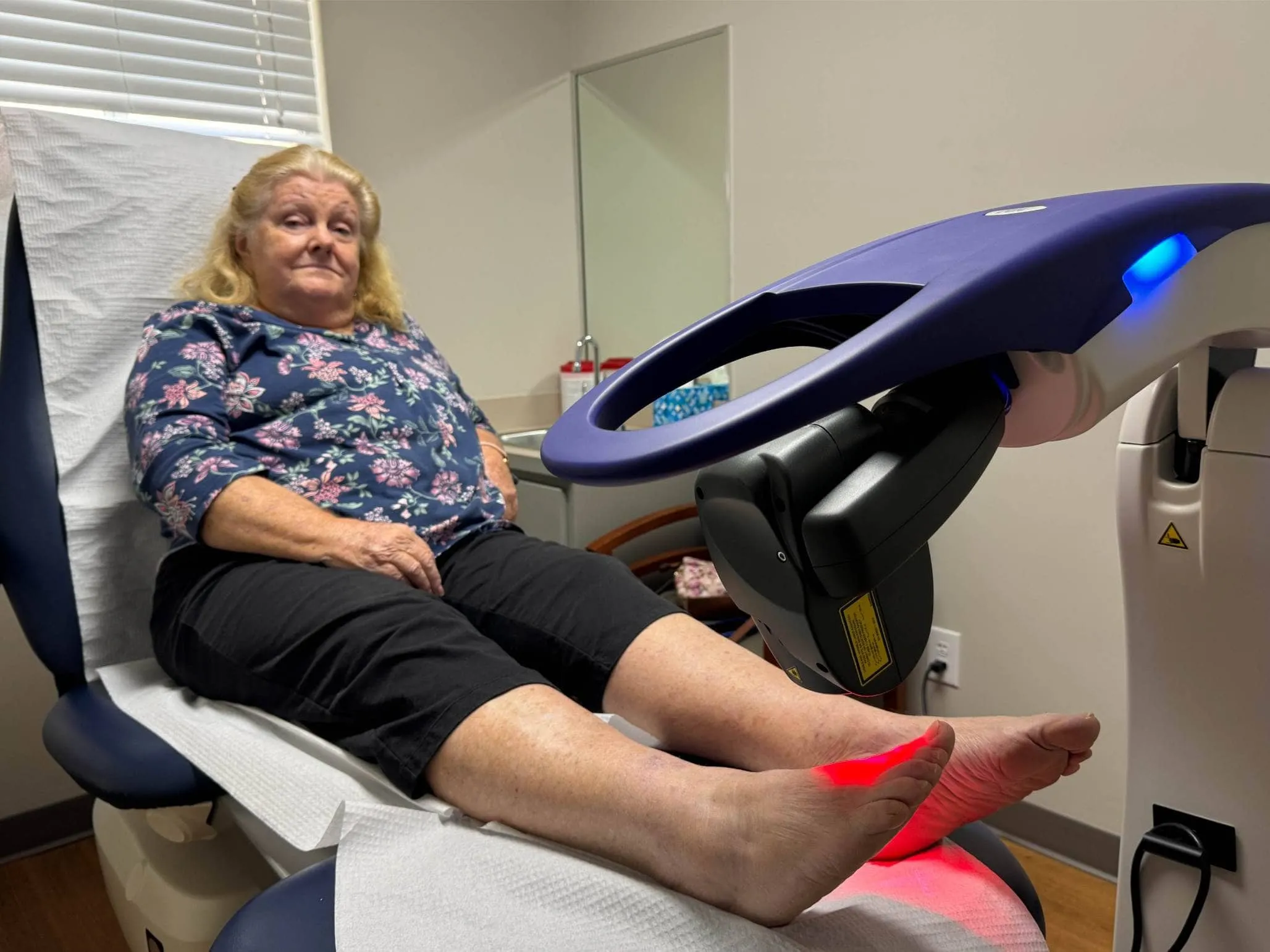
Regenerative medicine for foot pain uses non-surgical treatments that support the body's healing response. At Emerald Coast Foot and Ankle Center, a typical plan combines a Wharton's jelly allograft injection with Pulse Wave Therapy or Musculoskeletal Laser Therapy over seven weekly visits.
If you've lived with heel pain, tendon pain or aching joints for months, you've probably tried rest, stretching, new shoes and anti-inflammatory medication. When those help only a little, many patients assume surgery is the next step. For some chronic conditions, regenerative medicine offers another option. Dr. Carl Speer, a board-certified podiatrist, uses regenerative protocols to address the underlying area of injury rather than only masking symptoms. This guide explains how the treatment works, who it may help and what the seven weeks look like.
What Is Regenerative Medicine in Podiatry?
A different approach to chronic pain
Regenerative medicine focuses on supporting the body's natural healing processes, reducing inflammation and supporting damaged tissue without traditional surgery. Rather than focusing only on temporary symptom relief, the goal is to address the underlying area of injury or tissue dysfunction while helping reduce pain and improve function. Read the full overview on our regenerative medicine page.
Minimally invasive and non-surgical
These treatments are minimally invasive and non-surgical, designed with little to no downtime for patients.
Tailored to each patient
Your treatment plan is individualized based on your condition, examination findings and treatment goals.
Which Conditions Can It Help?
Regenerative medicine may be considered for:
- Plantar fasciitis and chronic heel pain
- Tendon pain, including Achilles, peroneal and posterior tibial tendons
- Joint inflammation and pain
- Soft tissue injuries
- Chronic foot and ankle pain
Our blog posts on heel pain treatment and tendon pain explain those conditions in more detail.
What Is Wharton's Jelly?
A connective tissue allograft
Wharton's jelly is a connective tissue allograft derived from donated umbilical tissue. It's used as a structural tissue supplement and is applied directly to the targeted area.
What it provides
The allograft provides cushioning, structural support and a natural extracellular matrix scaffold at the treatment site. We use this connective tissue supplementation to address structural defects that may be the root cause of a patient's pain or dysfunction.
A quick injection
The injection procedure itself typically takes approximately 3 minutes.
What Are Pulse Wave Therapy and Laser Therapy?
Pulse Wave Therapy
Pulse Wave Therapy is a non-invasive treatment that delivers targeted acoustic pressure waves to the affected area. It's used to stimulate a local healing response and support recovery in chronically painful or injured tissues.
Musculoskeletal Laser Therapy
Musculoskeletal Laser Therapy uses targeted light energy as a non-invasive treatment for painful or injured tissues. It may be incorporated into your plan to support tissue recovery, help manage inflammation and improve comfort and function.
Why combine treatments?
Our seven-week protocol combines complementary approaches. Pulse Wave Therapy or Musculoskeletal Laser Therapy is performed during six of the seven visits, while the Wharton's jelly allograft injection is given in the third week. The specific therapy is selected based on your condition.
What Does the 7-Week Plan Look Like?
A typical plan consists of one appointment per week for seven weeks.
| Week | Treatment |
|---|---|
| --- | --- |
| Week 1 | Pulse Wave Therapy or Musculoskeletal Laser Therapy |
| Week 2 | Pulse Wave Therapy or Musculoskeletal Laser Therapy |
| Week 3 | Wharton's jelly allograft injection |
| Week 4 | Pulse Wave Therapy or Musculoskeletal Laser Therapy |
| Week 5 | Pulse Wave Therapy or Musculoskeletal Laser Therapy |
| Week 6 | Pulse Wave Therapy or Musculoskeletal Laser Therapy |
| Week 7 | Pulse Wave Therapy or Musculoskeletal Laser Therapy |
Fitting it into your week
Because visits are weekly and downtime is minimal, most patients fit treatment around work and family. Our Pensacola office on Spanish Trail is open Monday through Thursday, 8:00 a.m. to 4:30 p.m., and Friday mornings.
During the program
Dr. Speer will give you guidance on activity, footwear and home care during the program, based on your condition.
Who Is a Good Candidate?
Persistent pain despite conservative care
If you're living with persistent foot or ankle pain and want a non-surgical option, regenerative medicine may be worth considering.
A thorough evaluation comes first
A comprehensive evaluation with Dr. Speer helps determine the source of your symptoms and whether this approach is appropriate. Our onsite digital X-rays can help identify problems such as stress fractures, heel spurs or joint degeneration that may change the plan.
When surgery may be the better choice
Structural problems like bunions, bunionettes and hammertoes are bone alignment issues. For those, Dr. Speer may recommend InvisiFoot™ minimally invasive surgery instead. The right treatment depends on the cause of your pain.
How Much Does Regenerative Medicine Cost?
Out-of-pocket treatment
Regenerative medicine treatments are an out-of-pocket service and are not covered by insurance. The total cost typically ranges from $1,000 to $3,000, depending on your condition and the plan Dr. Speer recommends. Your plan and total cost are reviewed with you before treatment begins.
Financing with Cherry
For patients who prefer to spread the cost over time, financing is available through Cherry, a buy now, pay later financing company, subject to approval and Cherry's terms.
What Results Can You Expect?
Individual results vary. Treatment recommendations are based on each patient's diagnosis and clinical evaluation, and no specific outcome or degree of improvement can be guaranteed. Dr. Speer will talk with you honestly about what to expect for your condition.
Why Choose Emerald Coast Foot and Ankle Center?
Direct care from a specialist
As a solo private practice, Dr. Speer provides direct, attentive care from start to finish. You won't be shuffled between providers. Learn more about Dr. Speer.
Fast appointments
We're committed to scheduling patients quickly and seeing them promptly at their appointment time.
Frequently Asked Questions
Is regenerative medicine surgery?
No. It's a minimally invasive, non-surgical treatment approach with little to no downtime.
How long does the treatment program take?
A typical plan is one appointment per week for seven weeks.
Does insurance cover regenerative medicine?
No. It's an out-of-pocket service. The total typically ranges from $1,000 to $3,000, and Cherry financing is available.
Can it help plantar fasciitis?
Plantar fasciitis and chronic heel pain are among the conditions we treat with regenerative medicine. An evaluation will determine whether it's right for you.
Explore Non-Surgical Relief in Pensacola
If chronic foot or ankle pain is holding you back, an evaluation is the first step. Visit our Pensacola office or request an appointment with Dr. Carl Speer to find out whether regenerative medicine fits your condition.